
Logistics Coordinator Assessment: A Real-Work Exercise for Hiring
A shipment is held at the port, the delivery window closes tomorrow and the carrier has not replied. This is a fictional illustration of the exercise Calavion would build with you.
Try CalavionWhat is a logistics coordinator assessment?
A logistics coordinator assessment is a way to check whether an applicant can do logistics coordination work before you hire them. Common formats are knowledge tests, situational questions, scheduling and planning exercises, document-checking tasks, role-play and interviews.
Calavion takes a practical approach. Working with a company, Calavion would turn a shipment situation your team has already handled, such as a shipment held at the port with a delivery window closing the next day, into a controlled exercise. The applicant would read the booking, the shipping documents and the carrier updates, then decide who to contact, what to change and what to tell the customer. You would then review a Replay: a record of what was available, what they did and wrote, what changed and what stayed open.
You will also see the same idea called a logistics coordinator skills test, shipping coordinator assessment, freight coordinator test, logistics job simulation or logistics coordinator case study. These terms are often used interchangeably, but they measure different things: some check knowledge, some check what applicants say they would do, and some let applicants do practical work.
What sets Calavion’s approach apart is the case. It would be your own handled shipment situation, you would approve the exact version, and you would read a Replay of what the applicant did and wrote.
Can you use Calavion for logistics coordinator assessments today? At a glance
- Best suited to
- Logistics coordination done in writing: carrier and customer emails, shipment notes, exception handling and handovers.
- What applicants would do
- Read bookings, tracking and shipping documents, decide what to chase, change or escalate, and write the messages and the shipment note.
- What employers would review
- A Replay of what was available, what the applicant did and wrote, what changed and what stayed open.
- What it does not do
- Connect to a real transport system, assess phone calls or radio dispatch, score or rank applicants, or claim to predict job performance.
- Status
- Not built yet. No logistics exercise has been built or run. Calavion builds each case with the company.
What would a real-work logistics coordinator assessment look like? Example: a shipment held at the port
It is 3 PM. A shipment is held at the port, the customer’s delivery window closes tomorrow, and the carrier has not replied to the first message. The documents list one detail that does not match the booking. The applicant decides what to check, whom to chase and what to tell the customer.
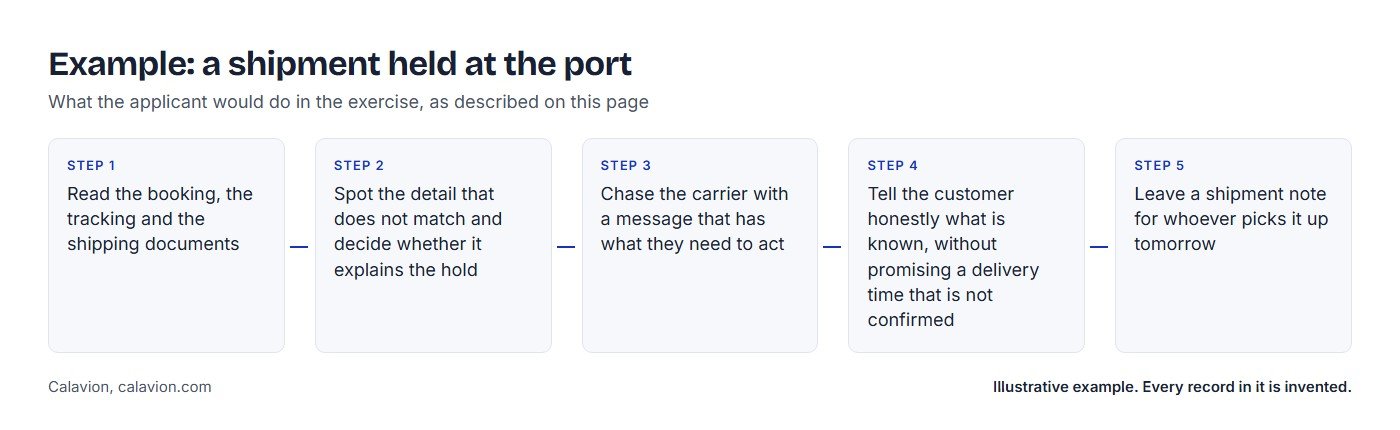
The applicant would
- Read the booking, the tracking and the shipping documents
- Spot the detail that does not match and decide whether it explains the hold
- Chase the carrier with a message that has what they need to act
- Tell the customer honestly what is known, without promising a delivery time that is not confirmed
- Leave a shipment note for whoever picks it up tomorrow
Each choice leaves the shipment in a different state: a carrier chased with a vague message, a customer promised a time nobody confirmed, a document error never raised. The employer would read the decisions, messages and action sequence in Replay.
This is an illustrative example. The shipment, the customer, the carrier and every record are invented.
Why should companies assess logistics coordinators before hiring?
Logistics work is judged one decision at a time: what a coordinator checks, whom they chase and what they promise. A resume lists past roles and systems, and an interview describes past behaviour. Neither directly shows how an applicant handles a held shipment, a document that does not match and a customer waiting for an answer. An assessment gives the company something observable to review before making an offer.
How would Calavion assess logistics skills?
Calavion is a real-work hiring platform. For logistics, Calavion would prepare a controlled exercise from a shipment situation your team has handled. Applicants would read records and write messages inside it, and you would read a Replay of what they did. You make the hiring decision.
- Bring one case. Choose a shipment situation your team has already handled.
- Calavion prepares it with you, by hand. Calavion reviews the material and replaces identifying details.
- You approve the exact version before any applicant sees it.
- Applicants work the case. They use an invite link, with no account, and work through records and written threads.
- You read Replay and decide. Replay shows what was available, what the applicant did and wrote, what changed and what stayed open.
What types of logistics coordinator assessment are there?
Employers combine several methods. This table shows what each one checks and where it stops.
| Type | What it checks | Strength | Limit |
|---|---|---|---|
| Knowledge test | Shipping terms, documents and processes | Quick to give and compare | Shows knowledge, not behaviour |
| Situational judgment test | Chosen answers to logistics scenarios | Standard scenarios are easy to compare | Shows what applicants say they would do |
| Planning or scheduling exercise | Arranging loads, routes or deliveries | Shows planning | Often generic, not your carriers or systems |
| Document-checking task | Finding mismatches in shipping documents | Shows attention to detail | Does not show communication |
| Writing sample | Drafting a delay notice to a customer | Shows clarity and tone | Does not show how the applicant read the records |
| Role-play | A rater plays a carrier or customer | Shows questioning and composure | Hard to repeat the same way for every applicant |
| Work sample | A task taken from the job | Job relevance depends on how well the task represents the role | Takes time to design |
| Structured interview | The same questions for every applicant | Consistent and easy to run | Asks about past or hypothetical situations; does not show work being done |
| Calavion real-work exercise | Your own handled shipment situation in a controlled environment | Observable actions, messages and consequences | Not built yet for logistics; written cases only; no automatic scores |
For the full method comparison, read work samples, job simulations, take-homes and real-work hiring.
Which logistics coordinator assessment should you use?
These are common pairings, not rules. Most teams use more than one method, and the right choice depends on the role.
| Hiring need | Commonly suitable method | What it can show | What it cannot establish |
|---|---|---|---|
| Freight and carrier coordination | A job simulation built on a real shipment exception | Chasing, wording and follow-through | Performance beyond the cases you chose |
| Shipping and documentation | A document-checking task plus a written work sample | Accuracy and clear notes | Real-time handling |
| Customer-facing logistics | A writing sample and a realistic delay case | Honest, clear updates | Planning skill |
| Scheduling and planning | A planning exercise with fixed constraints | Prioritising and trade-offs | Communication with carriers |
| High-volume hiring | A short knowledge test as a first filter, then a practical exercise for a shortlist | Basic knowledge at scale | What the applicant does with a real shipment situation |
| Any logistics role | A structured interview with the same questions for every applicant | Experience and how applicants explain their decisions | Work being done now |
How is a real-work logistics coordinator assessment different from a logistics coordinator skills test?
A logistics coordinator skills test, the kind sold in many assessment libraries, usually asks multiple-choice or scenario questions and scores them against an answer key. It is quick to give and easy to compare, and it shows what an applicant knows or says they would choose. A real-work logistics coordinator assessment, also called a logistics coordinator job simulation or work sample assessment, shows what the applicant does with a case from the job. Many teams use both: a short test early, and a practical exercise for the shortlist. Calavion offers only the second. See what a job simulation is and work sample or skills assessment test.
Which skills should a logistics coordinator assessment cover?
A useful assessment looks at the skills the job actually uses. Each skill below shows what it looks like in real work and what an employer would see in a Replay. Replay does not rate any trait. It shows the wording and the sequence of actions, and the employer interprets them.
| Skill | What it looks like in real work | What the employer would see in Replay |
|---|---|---|
| Reading shipment records | Using the booking, tracking and documents before acting | The records opened, and what the applicant referred to in the messages |
| Attention to detail | Noticing a mismatch in a document or a date | What the applicant flagged, and what they missed |
| Carrier and supplier communication | Writing messages the other side can act on | The messages the applicant wrote, word for word |
| Honest customer updates | Saying what is known without promising a time that is not confirmed | The promises in the customer message |
| Prioritisation | Judging which shipment is most urgent | What the applicant did first, and what they left |
| Problem solving | Finding options when a route or window fails | The options the applicant considered, and the one they chose |
| Escalation judgment | Knowing when to involve a manager or the carrier’s supervisor | Whether and when the applicant escalated, and what they said |
| Handover and documentation | Leaving a clear note on what is open | Outstanding responsibilities and the final state of the shipment |
Which logistics tasks can an assessment cover?
Logistics coordination happens by email, system updates, phone and radio. Written tasks can be assessed from the text alone. Calls and live dispatch need other methods.
| Task | How it is usually assessed | Calavion today |
|---|---|---|
| Phone and radio coordination | Live role-play with a rater | Not covered. Calavion does not record voice |
| Live transport or warehouse systems | A sandbox or demo-account task | Not covered. Calavion does not run live systems |
| Carrier and customer emails | Writing sample or simulation | Same written shape, but not built yet. Built with the company |
| Shipment exception notes | Work sample or simulation | Same written shape, but not built yet. Built with the company |
| Booking and document checks | Document-checking task | Same written shape, but not built yet. Built with the company |
How do you assess carrier calls and live system skills?
Calavion does not cover these, so you would use another method. These are common ways to assess them alongside a written exercise.
| Skill area | What a good test contains | Common method |
|---|---|---|
| Carrier or driver call | A scripted situation with hidden facts the applicant must find by asking | Role-play with a rater and a short rating guide |
| Transport or warehouse system use | A small task in a demo account, the same for every applicant | A sandbox task |
| Document accuracy | The same documents for every applicant with agreed errors planted | A document-checking task |
| Written updates | A short delay notice to a customer | A writing sample |
What a rater listens for in a carrier role-play
| What to listen for | Evidence that supports it | Evidence that raises a question |
|---|---|---|
| Questions | Asks short, clear questions about location, status and next step | Asks vaguely or all at once |
| Accuracy | Repeats back dates, references and quantities | Leaves details unconfirmed |
| Firmness | Presses politely for a firm answer and a time | Accepts a vague answer |
| Composure | Stays calm when the carrier is unhelpful | Becomes defensive or hurried |
| Closing | Confirms the next step, the owner and when they will hear back | Ends without a next step |
Which logistics roles can you assess this way?
Every role below needs its own case, which Calavion prepares with the company.
| Role | What the work involves | What to assess | Fit with Calavion |
|---|---|---|---|
| Logistics coordinator | Coordinating shipments, carriers and deliveries | Reading records, chasing and honest updates | Built with you |
| Shipping coordinator | Arranging and tracking outbound shipments | Accuracy, documents and customer wording | Built with you |
| Freight coordinator | Booking and following freight movements | Carrier communication and exception handling | Built with you |
| Import and export coordinator | Handling documents for cross-border shipments | Document accuracy and deadlines | Built with you |
| Transport planner | Planning loads and routes | Prioritising and trade-offs | Built with you |
| Warehouse coordinator | Coordinating inbound and outbound stock | Prioritising and clear notes | Built with you |
| Logistics team lead | Coordinating coordinators and escalations | Prioritising and handling escalations | Built with you |
| Dispatcher, mostly radio and phone | Directing drivers by voice | Verbal clarity and composure | Not covered: voice needs its own method |
If you hire for one of these roles, bring one case your team has handled and we will tell you whether it fits. See where Calavion applies and the design partner programme.
When should you use a real-work logistics coordinator assessment?
A work-based method lets you review the actions and messages an applicant produces inside a controlled exercise, and it asks more of you than an automated test. Here is what to expect before you start.
Best fit
- Logistics teams that coordinate carriers and customers through email and written updates
- Roles where reading records, attention to detail and honest wording matter together
- Hires where a missed deadline or a wrong document is costly, so reviewing real work may be worth the time
What it asks of you
- Setup is a hands-on service: Calavion prepares each exercise with you, by hand. It is not self-serve software
- You review the Replay yourself, because Calavion does not score or rank applicants
- It is not an automated screening tool for very large applicant pools, and it does not assess calls, radio dispatch or live system skills
How do you run a logistics coordinator assessment?
Step by step
Start from the real job
List the three or four situations that most often go wrong in the role.
Choose one real case
Pick a shipment situation your team has handled, with documents and tracking to read, a deadline that limits what can be promised, and a consequence that follows.
Decide in advance what you will look for
For example reading the records, prioritising, carrier and customer wording, and follow-through.
Give every applicant the same case
Use the same instructions for every applicant.
Keep it job-related
Tell applicants what is recorded and who sees it.
Review the work itself
Look at the work, not only the final answer.
Use what you saw to shape the interview
Ask about what the applicant actually did.
Keep your own notes
Apply your local hiring rules, taking legal advice where needed.
What should you look for in an applicant’s work?
These are observations to discuss, not scores. Calavion does not currently score or rate applicants, and the employer decides.
Signs to ask about
- Chases the carrier without the details they need
- Promises a delivery time nobody has confirmed
- Misses a mismatch in the documents
- Leaves the customer without an update
- Leaves a shipment note that tells the next person nothing
Signs of careful work
- Reads the booking, tracking and documents before writing
- Spots and names the document mismatch
- Chases with the references and facts the carrier needs
- Tells the customer what is known and what is not
- Escalates with a clear note
- Hands over unresolved work clearly
Logistics Coordinator interview questions and a note-taking guide
Use this guide to take your own notes against criteria you set in advance. It is a note-taking guide, not a score, and Calavion does not rate applicants. The table works from an exercise. The questions below it work without one.
| What to look at | Evidence that supports it | Evidence that raises a question | A question to ask |
|---|---|---|---|
| Reading records | Refers to the booking and tracking in the messages | Writes without checking the records | What did you check first, and why? |
| Attention to detail | Names the mismatch in the documents | Does not notice it | What did you find in the documents? |
| Carrier message | Includes references, dates and a clear request | Sends a vague chase | What did you ask the carrier to do, and by when? |
| Customer update | Says what is known and what is not | Promises a time nobody confirmed | What did you tell the customer, and what did you leave out? |
| Timing | Acts early given the closing window | Waits for the carrier to reply first | What would you do differently with another hour? |
| Ownership | Leaves a clear shipment note | Leaves open items unnamed | What was still open when you finished, and who owns it? |
Questions that work without an exercise
- A shipment is held and the carrier is not answering. What do you do first?
- Tell me about a time you found an error in shipping documents.
- How do you tell a customer a delivery will be late when you do not yet know by how much?
- How do you decide which shipment to deal with first on a busy day?
- When do you escalate to a manager, and what do you include?
- How do you write a shipment note so the next person can pick it up?
What does research say about selection methods?
Calavion makes no claim that its exercise has been validated. These independent sources explain how work samples and selection methods are usually judged.
U.S. Office of Personnel Management
OPM describes work sample tests as tests that require applicants to perform tasks that mirror the tasks employees perform on the job. It says they suit situations where applicants are expected to have the required skills when they start. Work samples and simulations (OPM).
Research on selection methods
A 2022 review in the Journal of Applied Psychology revisited how well common selection methods predict job performance and ranked structured interviews highest among the methods it reviewed. Sackett, Zhang, Berry and Lievens (2022).
Legal context in the United States
The Uniform Guidelines on Employee Selection Procedures set out how employers should show that a selection procedure is job-related, including technical standards for validity studies. Rules differ by country and state, so take legal advice for your location. 29 CFR Part 1607.
What do applicants experience, and what is recorded?
This describes how Calavion’s exercise environment works today for customer service. A logistics exercise would work the same way. Every applicant invited to the same approved exercise works the same approved version, with the same starting records and available actions. Applicants see a notice before they start. Calavion records what applicants do inside the environment: records opened, messages written and actions taken. It does not record the screen, webcam or keystrokes. Source files are never shown to applicants.
Logistics Coordinator assessment: common questions
Short answers to what companies ask most often about assessing logistics coordinators.
Does Calavion offer a logistics exercise today?
No. No logistics exercise has been built or run yet. Calavion would build the first one with a company, from a shipment situation it has handled. The only exercise Calavion has run end to end is a customer service cancellation case.
What is a logistics coordinator assessment?
A logistics coordinator assessment checks whether an applicant can do logistics coordination work before you hire them. Formats include knowledge tests, situational questions, scheduling and planning exercises, document-checking tasks, role-play and interviews. Calavion would use a real-work exercise built from a shipment situation your company has handled.
How do you assess a logistics coordinator when hiring?
Use work that resembles the job. Give applicants a shipment situation with the records they would really read and a message to write, review what they did, then discuss it in the interview. A multiple-choice test shows knowledge or stated judgment, and an interview describes past or hypothetical behaviour. Neither shows the work itself.
What skills should a logistics coordinator assessment cover?
It should cover the skills the job uses: reading shipment records, attention to detail, carrier and supplier communication, honest customer updates, prioritisation, problem solving, escalation judgment, and handover and documentation.
What is a logistics coordinator job simulation?
A logistics coordinator job simulation is an exercise in which an applicant handles a realistic shipment situation instead of answering questions about one. Calavion’s version would be built from a case your own company handled, so the bookings, documents and carriers are yours.
Can Calavion test live transport or warehouse system skills?
Not today. Calavion’s environment is built around written cases with records and message threads. It does not run live transport or warehouse systems, so those need a sandbox or demo-account task.
Does the exercise test phone or radio skills?
No. In Calavion’s exercise environment, applicants work in written threads and free-text replies. Calavion records what applicants do inside the environment: records opened, messages written and actions taken. It does not record the screen, webcam, keystrokes or voice.
How is a logistics coordinator assessment different from an interview?
An interview asks applicants to describe how they would act or how they acted before. An assessment shows work the applicant does now. Calavion does not replace the interview. It gives the interview something concrete to examine.
Does Calavion score logistics coordinator applicants?
Calavion does not currently produce automatic scores, applicant rankings or hiring decisions. Employers inspect the work and make the decision.
Do logistics assessments predict job performance?
No assessment guarantees performance, and Calavion does not claim to predict it. Calavion shows observable work so that you can judge it yourself and then discuss it in the interview.
Can applicant actions affect real shipments, carriers or customers?
No. In Calavion’s exercises, applicants work in a controlled environment connected to no real shipment, carrier or customer, and a logistics exercise would work the same way.
What is Replay?
Replay is the record an employer reads after an applicant finishes the exercise. It shows what was available, what the applicant did and wrote, what changed and what stayed open. It is not a score.
Is a real-work logistics coordinator assessment fair and legal?
That depends on where you hire and how you use it. Keep the criteria job-related, give every applicant the same case, tell applicants what is recorded and take legal advice for your location. Calavion makes no claim that its exercise removes bias or has been validated.
Can applicants use AI during a logistics coordinator assessment?
That depends on the role. Decide it before you invite applicants and tell them the rules before they start. Calavion’s direction is to allow AI where the role permits it, with the rules fixed and disclosed up front. Replay shows what applicants did and wrote inside the exercise.
Is the exercise accessible?
Calavion has checked keyboard use and responsive layouts. Screen-reader testing and a formal accommodation process are not yet established, so do not assume full accessibility compliance. Plan adjustments for applicants who need them and tell applicants who to contact.
How long should a logistics coordinator assessment be?
It should match the length of the work it represents. The right length depends on the case, and Calavion does not claim a universal time limit.
What are the trade-offs of a real-work logistics coordinator assessment?
Each exercise is prepared with you by hand, and you review the Replay yourself because Calavion does not score or rank applicants. That takes more effort than an automated test. It suits teams hiring for roles where judgment matters more than volume.
How do we start?
Bring one shipment situation your team has already handled. Calavion prepares the exercise with you, you approve it, and you invite applicants. Launch access is free for our first three companies. After that, Starter is $49 a month and Business is $149 a month, and Enterprise is quoted. See pricing, become a design partner or request a demo.
What has Calavion run so far?
Calavion has run one exercise end to end: a customer service cancellation case, tested on the live system using fictional company data. A logistics exercise would be built with you, from a shipment situation your team has handled.
See the operations coordinator assessment, the customer service assessment, the e-commerce customer support assessment, the technical support assessment, the account manager assessment, the recruiter assessment, how Replay works, what real-work hiring is and all roles.
Further reading: How to choose real work for a hiring exercise, How much context entry-level applicants should receive and When unfinished work is the responsible outcome. Related role guides: dispatcher assessment and procurement assessment. More role guides: inventory controller assessment. Role family: Operations and supply chain roles.
Build this exercise with us.
Bring one shipment situation your team has handled. Launch access is free for our first three companies. Calavion prepares the exercise with you, by hand, and you approve it before any applicant sees it.