
Sales Development Representative Assessment: A Real-Work Exercise for Hiring
A prospect replies to a cold email with a vague question, the research notes are thin and the next step has to be defensible. This is a fictional illustration of the exercise Calavion would build with you.
Try CalavionWhat is a sales development representative assessment?
A sales development representative assessment is a way to check whether an applicant can do sales development work before you hire them. Common formats are sales knowledge tests, situational judgement tests, email-writing exercises, cold-call role-plays, case studies and interviews.
Calavion takes a practical approach. Working with a company, Calavion would turn a prospecting situation your team has already handled, such as a vague prospect reply and a next step that has to be defensible, into a controlled exercise. The applicant would read the prospect notes, the reply and the qualification guide, then decide whether to qualify, what to ask and what to book or drop. You would then review a Replay: a record of what was available, what they did and wrote, what changed and what stayed open.
You will also see the same idea called an SDR skills test, a business development representative assessment, an SDR pre-employment assessment, an SDR job simulation, a work sample assessment for sales development reps or an SDR case study. These terms are often used interchangeably, but they measure different things: some check knowledge, some check what applicants say they would do, and some let applicants do practical work.
What sets Calavion’s approach apart is the case. It would be your own handled prospecting situation, you would approve the exact version, and you would read a Replay of what the applicant did and wrote.
Can you use Calavion for sales development representative assessments today? At a glance
- Best suited to
- Sales development done in writing: researching prospects, replying to inbound messages, qualifying and choosing a defensible next step.
- What applicants would do
- Read prospect notes, a reply and a qualification guide, decide whether the lead is worth a meeting, and write the reply and the handover to an account executive.
- What employers would review
- A Replay of what was available, what the applicant did and wrote, what changed and what stayed open.
- What it does not do
- Connect to real CRM or email tools, assess cold calling by voice, test sales-tool skills, score or rank applicants, or claim to predict job performance.
- Status
- Not built yet. No sales development exercise has been built or run. Calavion builds each case with the company.
What would a real-work sales development representative assessment look like? Example: a vague reply and a defensible next step
It is Monday. A prospect at a 200-person company has answered a cold email with one line, ‘Interesting, how does it work?’, the research notes show a new head of operations and no budget information, and the qualification guide says a meeting is booked only when there is a named problem and an owner. The applicant decides how to reply, whether to qualify further and what to hand over.
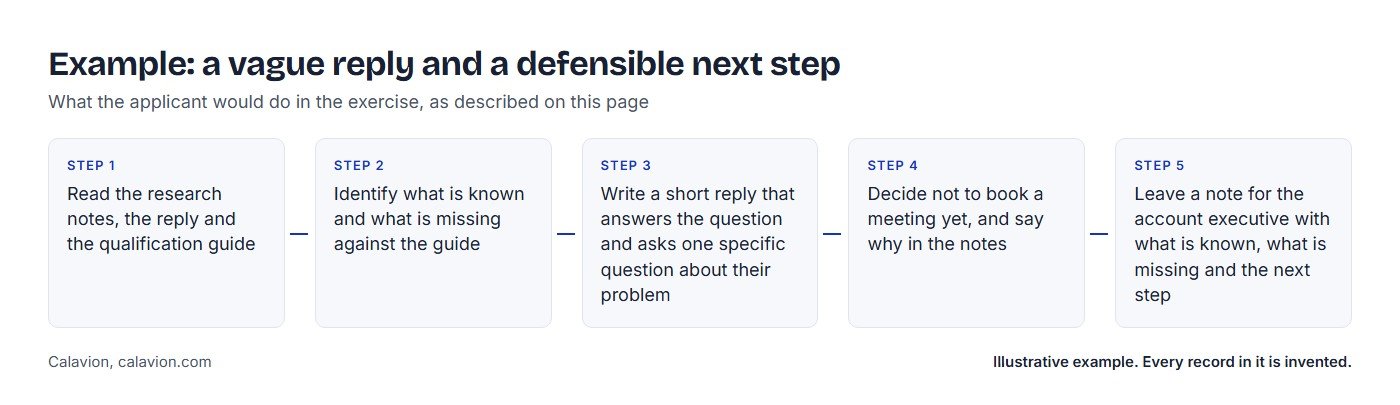
The applicant would
- Read the research notes, the reply and the qualification guide
- Identify what is known and what is missing against the guide
- Write a short reply that answers the question and asks one specific question about their problem
- Decide not to book a meeting yet, and say why in the notes
- Leave a note for the account executive with what is known, what is missing and the next step
Each choice leaves the lead in a different state: a meeting booked with no problem identified, a reply that is all pitch and no question, a handover note that says only ‘interested’. The employer would read the decisions, messages and action sequence in Replay.
This is an illustrative example. The company, the prospect and every record are invented.
Why should companies assess sales development representatives before hiring?
Sales development is judged one lead at a time: what a representative asks, qualifies and hands on. A resume lists quotas and tools, and an interview describes past pipeline. Neither directly shows how an applicant handles a vague reply, thin research and a rule about when to book. An assessment gives the company something observable to review before making an offer.
How would Calavion assess sales development skills?
Calavion is a real-work hiring platform. For sales development, Calavion would prepare a controlled exercise from a prospecting situation your team has handled. Applicants would read records and write messages inside it, and you would read a Replay of what they did. You make the hiring decision.
- Bring one case. Choose a prospecting situation your team has already handled.
- Calavion prepares it with you, by hand. Calavion reviews the material and replaces identifying details.
- You approve the exact version before any applicant sees it.
- Applicants work the case. They use an invite link, with no account, and work through records and written threads.
- You read Replay and decide. Replay shows what was available, what the applicant did and wrote, what changed and what stayed open.
What types of sales development representative assessment are there?
Employers combine several methods. This table shows what each one checks and where it stops.
| Type | What it checks | Strength | Limit |
|---|---|---|---|
| Knowledge test | Sales terms, qualification frameworks and common tools | Quick to give and compare | Shows knowledge, not behaviour |
| Situational judgment test | Chosen answers to sales development scenarios | Standard scenarios are easy to compare | Shows what applicants say they would do |
| Knowledge test | Sales terms and qualification frameworks | Quick and easy to compare | Shows knowledge, not behaviour |
| Email-writing exercise | Writing a cold email or a reply | Shows writing and tone | Often generic, not your product or your prospects |
| Cold-call role-play | A rater plays a prospect on the phone | Shows composure and questioning | Hard to repeat the same way for every applicant |
| Case study | Analysing a described prospect | Shows reasoning | Does not show how the applicant handles a live reply |
| Work sample | A task taken from the job | Job relevance depends on how well the task represents the role | Takes time to design |
| Structured interview | The same questions for every applicant | Consistent and easy to run | Asks about past or hypothetical situations; does not show work being done |
| Calavion real-work exercise | Your own handled prospecting situation in a controlled environment | Observable actions, messages and consequences | Not built yet for sales development; written cases only; no automatic scores |
For the full method comparison, read work samples, job simulations, take-homes and real-work hiring.
Which sales development representative assessment should you use?
These are common pairings, not rules. Most teams use more than one method, and the right choice depends on the role.
| Hiring need | Commonly suitable method | What it can show | What it cannot establish |
|---|---|---|---|
| Qualifying and replying to prospects | A job simulation built on a real prospecting case | Judgment, questions and wording | Performance beyond the leads you chose |
| Writing outreach | A writing sample with the same brief for every applicant | Clarity and tone | How the applicant qualified |
| Cold calling | A role-play with a rater | Composure and questioning by voice | Written organisation |
| Sales knowledge | A short knowledge test | Terms and frameworks | What the applicant does with a real lead |
| High-volume hiring | A short knowledge test as a first filter, then a practical exercise for a shortlist | Basic knowledge at scale | What the applicant does with a real prospecting situation |
| Any sales development role | A structured interview with the same questions for every applicant | Experience and how applicants explain their decisions | Work being done now |
How is a real-work sales development representative (SDR) assessment different from a sales development representative (SDR) skills test?
A sales development representative (SDR) skills test, the kind sold in many assessment libraries, usually asks multiple-choice or scenario questions and scores them against an answer key. It is quick to give and easy to compare, and it shows what an applicant knows or says they would choose. A real-work sales development representative (SDR) assessment, also called a sales development representative (SDR) job simulation or work sample assessment, shows what the applicant does with a case from the job. Many teams use both: a short test early, and a practical exercise for the shortlist. Calavion offers only the second. See what a job simulation is and work sample or skills assessment test.
Which skills should a sales development representative assessment cover?
A useful assessment looks at the skills the job actually uses. Each skill below shows what it looks like in real work and what an employer would see in a Replay. Replay does not rate any trait. It shows the wording and the sequence of actions, and the employer interprets them.
| Skill | What it looks like in real work | What the employer would see in Replay |
|---|---|---|
| Reading the notes | Using the research, reply and guide before acting | The records opened, and what the applicant referred to in the reply |
| Qualifying | Comparing the lead with the qualification rule | Whether the applicant named what is known and missing |
| Asking one good question | Moving a vague reply towards a named problem | The question the applicant wrote, word for word |
| Concise replies | Answering without a pitch | The reply as written, and whether it answered the question |
| Judgment about when to book | Booking only when the rule is met | Whether a meeting was booked, and the reason in the notes |
| Honesty | Not overstating fit or promising what the product cannot do | Whether any claim was made that the notes did not support |
| Escalation and handover | Giving the account executive what they need | The handover note, word for word |
| Follow-up planning | Choosing a sensible next step and date | The follow-up the applicant set |
Which sales development tasks can an assessment cover?
Sales development happens in CRMs, email, social platforms and on the phone. Written tasks with notes and a guide can be assessed from the text alone. Cold calling and tool skill need other methods.
| Task | How it is usually assessed | Calavion today |
|---|---|---|
| Cold calling | Live role-play with a rater | Not covered. Calavion does not record voice or video |
| CRM and sales-tool skills | A task in a demo or sandbox tool | Not covered. Calavion does not run live sales tools |
| Reading prospect notes and qualifying | Work sample or simulation | Same written shape, but not built yet. Built with the company |
| Replies to inbound messages | Writing sample or simulation | Same written shape, but not built yet. Built with the company |
| Handover notes to account executives | Work sample | Same written shape, but not built yet. Built with the company |
How do you assess cold calling and sales tools?
Calavion does not cover these, so you would use another method. These are common ways to assess them alongside a written exercise.
| Skill area | What a good test contains | Common method |
|---|---|---|
| Cold call | A scripted prospect with a brush-off and a hidden problem | Role-play with a rater and a short rating guide |
| CRM skill | The same records and steps for every applicant | A task in a demo or sandbox tool |
| Research skill | The same company and a time limit | A research task with a written summary |
| Written outreach | A short cold email with the same brief for everyone | A writing sample |
What a rater listens for in a cold-call role-play
| What to listen for | Evidence that supports it | Evidence that raises a question |
|---|---|---|
| Opening | States who they are and why in a few words | Rambles or reads a script |
| Questions | Asks about the prospect’s situation | Pitches before asking |
| Handling a brush-off | Stays polite and asks one more question | Pushes or gives up at once |
| Honesty | Does not overstate what the product does | Claims fit without evidence |
| Closing | Agrees a clear next step or ends cleanly | Ends without a next step |
Which sales development roles can you assess this way?
Every role below needs its own case, which Calavion prepares with the company.
| Role | What the work involves | What to assess | Fit with Calavion |
|---|---|---|---|
| Sales development representative | Qualifying leads and booking meetings | Questions, honesty and judgment | Built with you |
| Business development representative | Finding and qualifying new business | Research, questions and replies | Built with you |
| Inbound lead qualifier | Qualifying inbound enquiries | Questions and concise replies | Built with you |
| Appointment setter | Booking meetings for sales teams | Clear messages and accuracy | Built with you |
| Sales operations specialist | Supporting sales with data and process | Accuracy and clear notes | Built with you |
| Inside sales representative | Selling by phone and email | Objections and follow-up. See the sales representative guide | Built with you |
| Account executive, mostly live demos | Running demos and closing deals | Presenting and negotiating live | Not covered: demos and live negotiation need their own methods |
| Telemarketer, mostly phone | Calling large lists by phone | Voice conduct | Not covered: phone work needs its own method |
If you hire for one of these roles, bring one case your team has handled and we will tell you whether it fits. See where Calavion applies and the design partner programme.
When should you use a real-work sales development representative assessment?
A work-based method lets you review the actions and messages an applicant produces inside a controlled exercise, and it asks more of you than an automated test. Here is what to expect before you start.
Best fit
- Sales teams that qualify leads through email, notes and a written qualification guide
- Roles where asking good questions, honesty and judgment about when to book matter together
- Hires where wasted meetings or an overstated promise are costly, so reviewing real work may be worth the time
What it asks of you
- Setup is a hands-on service: Calavion prepares each exercise with you, by hand. It is not self-serve software
- You review the Replay yourself, because Calavion does not score or rank applicants
- It is not an automated screening tool for very large applicant pools, and it does not assess cold calling or sales-tool skills
How do you run a sales development representative assessment?
Step by step
Start from the real job
List the three or four situations that most often go wrong in the role.
Choose one real case
Pick a prospecting situation your team has handled, with prospect notes, an inbound reply and a qualification guide to read, a rule that limits what can be promised, and a consequence that follows.
Decide in advance what you will look for
For example reading the notes, qualifying, wording follow-ups, and choosing a next step.
Give every applicant the same case
Use the same instructions for every applicant.
Keep it job-related
Tell applicants what is recorded and who sees it.
Review the work itself
Look at the work, not only the final answer.
Use what you saw to shape the interview
Ask about what the applicant actually did.
Keep your own notes
Apply your local hiring rules, taking legal advice where needed.
What should you look for in an applicant’s work?
These are observations to discuss, not scores. Calavion does not currently score or rate applicants, and the employer decides.
Signs to ask about
- Books a meeting with no problem identified
- Replies with a pitch and no question
- Claims the product fits without evidence
- Hands over a note that says only ‘interested’
- Sets no follow-up date
Signs of careful work
- Reads the notes, reply and guide before replying
- Names what is known and what is missing
- Asks one specific question about their problem
- Books only when the rule is met
- Gives the account executive a clear summary
- Sets a sensible follow-up
Sales Development Representative interview questions and a note-taking guide
Use this guide to take your own notes against criteria you set in advance. It is a note-taking guide, not a score, and Calavion does not rate applicants. The table works from an exercise. The questions below it work without one.
| What to look at | Evidence that supports it | Evidence that raises a question | A question to ask |
|---|---|---|---|
| Reading the notes | Refers to the research and the reply | Replies without checking | What did you check first, and why? |
| Qualification | Compares the lead with the guide | Qualifies on enthusiasm | What did the guide require, and what was missing? |
| Reply | Short, answers the question and asks one question | All pitch | What did you ask the prospect, and why? |
| Booking decision | Books only when the rule is met and says why | Books to hit a target | Why did you book or not book? |
| Honesty | Claims only what the notes support | Overstates fit | What did you say the product can do? |
| Handover | Clear note with known, missing and next step | Vague note | What did you tell the account executive? |
Questions that work without an exercise
- A prospect replies with a vague question. What do you do first?
- Tell me about a time you decided not to book a meeting.
- How do you qualify a lead when you have little information?
- How do you handle a brush-off without pushing?
- How do you avoid overstating what your product does?
- How do you hand a lead to an account executive?
What does research say about selection methods?
Calavion makes no claim that its exercise has been validated. These independent sources explain how work samples and selection methods are usually judged.
U.S. Office of Personnel Management
OPM describes work sample tests as tests that require applicants to perform tasks that mirror the tasks employees perform on the job. It says they suit situations where applicants are expected to have the required skills when they start. Work samples and simulations (OPM).
Research on selection methods
A 2022 review in the Journal of Applied Psychology revisited how well common selection methods predict job performance and ranked structured interviews highest among the methods it reviewed. Sackett, Zhang, Berry and Lievens (2022).
Legal context in the United States
The Uniform Guidelines on Employee Selection Procedures set out how employers should show that a selection procedure is job-related, including technical standards for validity studies. Rules differ by country and state, so take legal advice for your location. 29 CFR Part 1607.
What do applicants experience, and what is recorded?
This describes how Calavion’s exercise environment works today for customer service. A sales development exercise would work the same way. Every applicant invited to the same approved exercise works the same approved version, with the same starting records and available actions. Applicants see a notice before they start. Calavion records what applicants do inside the environment: records opened, messages written and actions taken. It does not record the screen, webcam or keystrokes. Source files are never shown to applicants.
Sales Development Representative assessment: common questions
Short answers to what companies ask most often about assessing sales development representatives.
Does Calavion offer a sales development exercise today?
No. No sales development exercise has been built or run yet. Calavion would build the first one with a company, from a prospecting situation it has handled. The only exercise Calavion has run end to end is a customer service cancellation case.
What is a sales development representative assessment?
A sales development representative assessment checks whether an applicant can do sales development work before you hire them. Formats include sales knowledge tests, situational judgement tests, email-writing exercises, cold-call role-plays, case studies and interviews. Calavion would use a real-work exercise built from a prospecting situation your company has handled.
How do you assess a sales development representative when hiring?
Use work that resembles the job. Give applicants a prospecting situation with the records they would really read and a message to write, review what they did, then discuss it in the interview. A multiple-choice test shows knowledge or stated judgment, and an interview describes past or hypothetical behaviour. Neither shows the work itself.
What skills should a sales development representative assessment cover?
It should cover the skills the job uses: reading the notes, qualifying, asking one good question, concise replies, judgment about when to book, honesty, escalation and handover, and follow-up planning.
What is an SDR job simulation?
An SDR job simulation is an exercise in which an applicant handles a realistic prospecting situation instead of answering questions about one. Calavion’s version would be built from a case your own team handled, so the notes, replies and qualification guide are yours.
How is an SDR different from a sales representative?
The titles are used loosely. A sales development representative usually finds and qualifies leads and books meetings, while a sales representative usually runs the sale and closes. See the sales representative assessment.
Can Calavion test cold calling?
No. Calavion’s environment is built around written cases with records and message threads. It does not record voice or video, so cold calling needs a role-play with a rater.
How is a sales development representative assessment different from an interview?
An interview asks applicants to describe how they would act or how they acted before. An assessment shows work the applicant does now. Calavion does not replace the interview. It gives the interview something concrete to examine.
Does Calavion score sales development representative applicants?
Calavion does not currently produce automatic scores, applicant rankings or hiring decisions. Employers inspect the work and make the decision.
Do sales development assessments predict job performance?
No assessment guarantees performance, and Calavion does not claim to predict it. Calavion shows observable work so that you can judge it yourself and then discuss it in the interview.
Can applicant actions affect real prospects, leads or sales tools?
No. In Calavion’s exercises, applicants work in a controlled environment connected to no real prospect, lead or sales tool, and a sales development exercise would work the same way.
What is Replay?
Replay is the record an employer reads after an applicant finishes the exercise. It shows what was available, what the applicant did and wrote, what changed and what stayed open. It is not a score.
Is a real-work sales development representative assessment fair and legal?
That depends on where you hire and how you use it. Keep the criteria job-related, give every applicant the same case, tell applicants what is recorded and take legal advice for your location. Calavion makes no claim that its exercise removes bias or has been validated.
Can applicants use AI during a sales development representative assessment?
That depends on the role. Decide it before you invite applicants and tell them the rules before they start. Calavion’s direction is to allow AI where the role permits it, with the rules fixed and disclosed up front. Replay shows what applicants did and wrote inside the exercise.
Is the exercise accessible?
Calavion has checked keyboard use and responsive layouts. Screen-reader testing and a formal accommodation process are not yet established, so do not assume full accessibility compliance. Plan adjustments for applicants who need them and tell applicants who to contact.
How long should a sales development representative assessment be?
It should match the length of the work it represents. The right length depends on the case, and Calavion does not claim a universal time limit.
What are the trade-offs of a real-work sales development representative assessment?
Each exercise is prepared with you by hand, and you review the Replay yourself because Calavion does not score or rank applicants. That takes more effort than an automated test. It suits teams hiring for roles where judgment matters more than volume.
How do we start?
Bring one prospecting situation your team has already handled. Calavion prepares the exercise with you, you approve it, and you invite applicants. Launch access is free for our first three companies. After that, Starter is $49 a month and Business is $149 a month, and Enterprise is quoted. See pricing, become a design partner or request a demo.
What has Calavion run so far?
Calavion has run one exercise end to end: a customer service cancellation case, tested on the live system using fictional company data. A sales development exercise would be built with you, from a prospecting situation your team has handled.
See the sales representative assessment, the account manager assessment, the marketing coordinator assessment, the customer success manager assessment, the recruiter assessment, how Replay works, what real-work hiring is and all roles.
Further reading: Work sample vs skills test, Work sample vs structured interview and How to debrief a practical hiring task. Role family: Sales and marketing roles.
Build this exercise with us.
Bring one prospecting situation your team has handled. Launch access is free for our first three companies. Calavion prepares the exercise with you, by hand, and you approve it before any applicant sees it.