
An accounts receivable clerk work sample test built from your own cases
A customer is 60 days overdue, disputes one line of the invoice and promises to pay on Friday. This is a fictional illustration of the exercise Calavion would build with you.
Try CalavionWhat is an accounts receivable clerk work sample test?
An accounts receivable clerk work sample test is a short exercise in which an applicant handles a real case from your own work, and you read a record of what they did. Calavion builds the case with you from work your team has handled, such as an overdue customer who disputes an invoice line. It does not score, rank or recommend applicants.
An accounts receivable clerk assessment usually asks what an applicant would do and scores the answers against a key. This asks them to do it: they open the records, check the credit policy and write to the customer, then decide. You read a Replay of what they did, and you decide.
People also search for this as an accounts receivable clerk skills test, an accounts receivable clerk job simulation or a work sample for accounts receivable clerks. The terms overlap, but they measure different things: some check knowledge, some check what applicants say they would do, and some let applicants do practical work.

What this accounts receivable clerk work sample test is, and is not
- Best suited to
- Accounts receivable work done in writing: reading customer accounts, chasing overdue invoices, handling disputes and handing over open items.
- What the applicant does
- Read an invoice, a payment history and a credit policy, decide what to chase, query or escalate, and write to the customer and the account owner.
- What you see
- A Replay of what was available, what the applicant did and wrote, what changed and what stayed open.
- What Calavion does not do
- Connect to real accounting systems, assess collection calls, test accounting standards or software skills, score or rank applicants, or claim to predict job performance.
- What exists today
- Not built. No accounts receivable clerk exercise has been built or run. One customer service exercise runs today, and Calavion would build a accounts receivable clerk case with you from work your team has handled.
What does a real-work accounts receivable clerk work sample test look like?
Example: an overdue customer who disputes an invoice line
It is Monday. A customer’s invoice is 60 days overdue, they dispute one line for a service they say was not delivered, and they have promised to pay on Friday. The credit policy says accounts over 60 days are put on hold unless a payment date is agreed in writing. The applicant decides what to chase, what to query and what to put in writing.
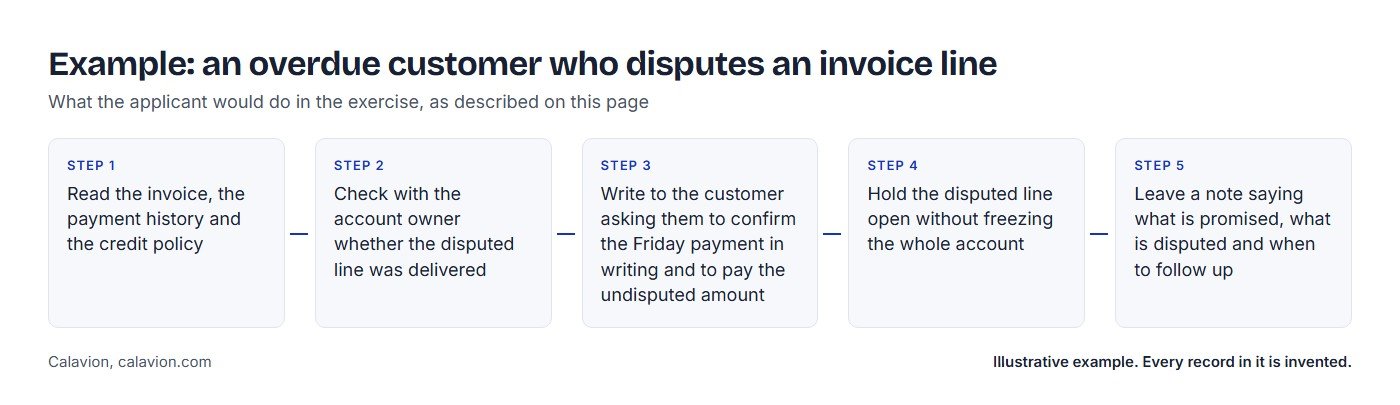
The applicant would
- Read the invoice, the payment history and the credit policy
- Check with the account owner whether the disputed line was delivered
- Write to the customer asking them to confirm the Friday payment in writing and to pay the undisputed amount
- Hold the disputed line open without freezing the whole account
- Leave a note saying what is promised, what is disputed and when to follow up
Each choice leaves the account in a different state: a customer put on hold unnecessarily, a promise taken on trust with no date in writing, a dispute left with nobody checking it. The employer would read the decisions, messages and action sequence in Replay.
This is an illustrative example. The company, the customer, the amounts and every record are invented.
How does it differ from other ways to test accounts receivable clerk candidates?
Employers combine several methods. This table shows what each one checks and where it stops.
| Type | What it checks | Strength | Limit |
|---|---|---|---|
| Knowledge test | Accounting terms, credit processes and common software | Quick to give and compare | Shows knowledge, not behaviour |
| Situational judgment test | Chosen answers to accounts receivable scenarios | Standard scenarios are easy to compare | Shows what applicants say they would do |
| Spreadsheet or software test | Using a spreadsheet or accounting tool | Quick and objective | Shows tool skill, not judgment |
| Work sample | A task taken from the job | Job relevance depends on how well the task represents the role | Takes time to design |
| Structured interview | The same questions for every applicant | Consistent and easy to run | Asks about past or hypothetical situations; does not show work being done |
| Calavion real-work exercise | Your own handled collections situation in a controlled environment | Observable actions, messages and consequences | Not built for accounts receivable; written cases only; no scores or rankings |
For the full method comparison, read work samples, job simulations, take-homes and real-work hiring.
Accounts receivable clerk work sample test: common questions
Short answers to what companies ask most often about assessing accounts receivable clerks.
Is this an accounts receivable clerk assessment test?
Not in the usual sense. An accounts receivable clerk assessment test checks knowledge or stated judgment and scores the answers. An accounts receivable clerk work sample test has the applicant handle a real case from your own work, and you read a Replay of what they did. Calavion produces no score, ranking or hiring decision.
What is an accounts receivable job simulation?
An accounts receivable job simulation is an exercise in which an applicant handles a realistic overdue account instead of answering questions about one. Calavion’s version would be built from a case your own company handled, so the invoices, history and credit policy are yours.
Does Calavion score accounts receivable clerk applicants?
No. Calavion does not produce scores, rankings or hiring decisions. Employers inspect the work and make the decision. For accounts receivable, Replay shows the invoice, payment history and credit policy the applicant opened, what they asked the customer to confirm and what they held open, and you decide whether the account was handled fairly and firmly.
Do accounts receivable work sample tests predict job performance?
No assessment guarantees performance, and Calavion does not claim to predict it. One overdue account shows how an applicant handled that account. Collection rates over a full ledger depend on many accounts and customers this exercise does not cover.
Does Calavion assess debt collection calls or legal compliance?
No. Calavion’s environment is built around written cases with records and message threads. It does not record voice or video and does not assess collection law, so phone collection and legal compliance need separate methods.
What has Calavion run so far?
Calavion has run one exercise end to end: a customer service cancellation case, tested on the live system using fictional company data. An accounts receivable exercise would be built with you, from a collections situation your team has handled.
See the accounts payable work sample test, the order management work sample test, the account manager work sample test, the customer service work sample test, the compliance analyst work sample test, how Replay works, what real-work hiring is and all roles.
Further reading: How to discuss applicant work without a score, Work sample vs structured interview and Work sample vs skills test. Role family: Finance and payroll roles. More role guides: bookkeeper work sample test. See also: credit analyst work sample test.
Build this exercise with us.
Bring one collections situation your team has handled. Launch access is free for our first three companies. Calavion prepares the exercise with you, by hand, and you approve it before any applicant sees it.